0xRay 4.0 — the suit
This page is the 4.0 record. The suit era is 4.1. The live ticket is .xray/state/STATION.md.
Public thesis: temperament and synchronicity move the stack from toolsets to factories. 4.0 is the suit for that shift. A foundry is built from mills and hangars. The mill builds and ships. The hangar is the shop.
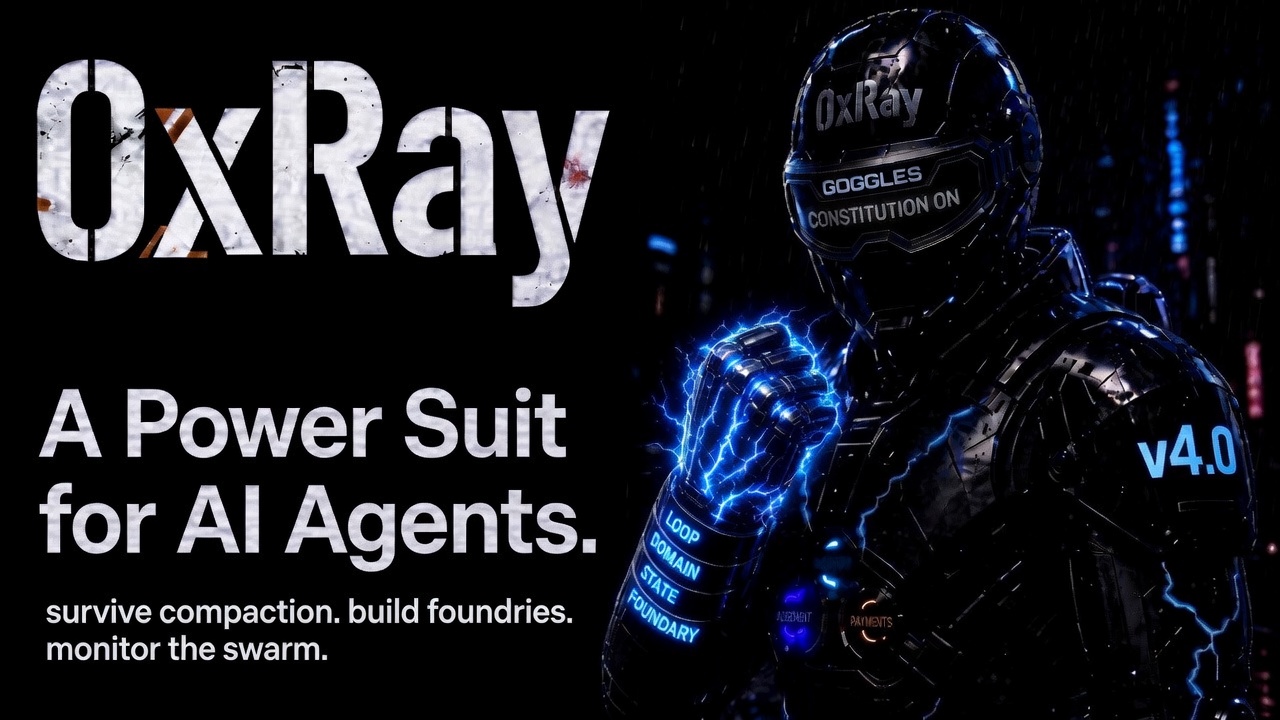
This page is the north star. Mechanism lives in suit temperament and 4.0 from v2. Fat vs bone is the trim list. Station card for the next session: 4.0 handoff. Mill vs exo: 4.0 foundry. What's still open: 4.0 left.
What 4.0 is (roots)
42 agents, 45 skills, and 7 MCP servers are organs. The product is the skeleton you wear. 0xRay is a three-subsystem autonomous engine. The suit is the wear.
| Layer | What it is |
|---|---|
| Bone | Three-subsystem engine: Inference · External Governance (Dynamo / Codex) · Autonomous Engine (thinDispatch) |
| Always on | Constitution: Codex 11 / 29 / 69, destructive shell, no new MCP/skill/handler surface |
| Temperament | frontier | guided | strict | auto — how loud the engine is, not whether governance exists |
| Wear | Grok, OpenCode, Hermes, OpenClaw, plus Cursor project hooks. One SSOT gate (evaluatePreToolGate) |
| Muscle | Station is the wake ticket (.xray/state/STATION.md). Repertoire 0.2 is 8 factory primitives for routing heat. It is the judgment index, and it is not 0.1.8. Station vs Repertoire 0.1. |
The exo is what the host puts on. The host still walks. Frontier models get honesty without a second planner. Guided hosts still get a floor boss because they will invent APIs.
Where we are
What is built and worn is a tempered three-subsystem engine with four bridges. The suit is the wear. That bone is real.
- Constitution fires on Grok, OpenCode, Hermes, and OpenClaw through one SSOT.
- Temperament is in
features.json. Missingsuit_temperamentstays guided so upgrades do not silently frontier a consumer. - Grok 4.6 class hosts (
profile: auto→ frontier): spawn-without-plan warns; confer off unless opted in. Codex still deniesany, Codex 29, and new surface. - OpenCode / Hermes / OpenClaw stay guided unless you say otherwise. Full ceremony: analyze-complexity, spawn-plan deny, confer.
- Inference pickle on this generation of hosts is OpenCode CLI (
opencode run), not a fifth provider 0xRay owns. Zen/Go HTTP catalogs are host env, not the suit. - npm is the 4.1 line. Stranger install (
npm i 0xray→ four-host--force) is the wear test, not a hero machine.
Where we are going
Factory, not toolset.
Toolset era = a bag of MCPs, skills, and agents you must remember to invoke.
Factory era = one plant. Same constitution on every floor. Memory compounds. Hosts are stations, not products. Temperament is the shift schedule. Synchronicity is gate + Dynamo + Repertoire as one wear, not seven chats.
| Going | Meaning |
|---|---|
| Kernel, not catalog | Ship the gate, temperament, four adapters, Repertoire hookup. Stop selling 42/45/7 as the product. |
| Factory wear | npm i 0xray lights constitution on this host in one shot. Stranger install is the release gate. |
| Foundry vs exo | Wear is the suit. The mill fashions mill plant (bridges, reconcile, gate, stamps) and fastens it on install. See foundry. |
| Synchronicity as muscle | Repertoire is the gap-filler for handoffs and compaction. 4.0 vendors @0xray/repertoire@0.2.0 and ships memory_routing.enabled: true. Opt out with "enabled": false, "provider": "repertoire". |
| Host-native inference | Use the plant’s existing line (OpenCode CLI, Grok OAuth, whatever the floor already runs). Do not add an 8th MCP. |
| Codex 69 as factory law | No new MCP/skill/handler. Trim duplicate conductors on the museum list. “Trim later” is now if this page is true. |
| Temperament as shifts | Frontier = the model runs the line, suit is PPE. Guided = suit is also the foreman. Strict = lock confer. Auto = pick by host. |
Not going: a fifth orchestrator for models that already grew up. Not going: chasing pickle by upgrading a host 17k commits. Not going: numbered agents on the chest.
The actual problem
Build a suit that survives the context window. Compaction is the name in this host. New session, host swap, model upgrade, plan → code → review — same physics: linear steps, each one can drop state, friction compounds.
These are not exotic research problems. They are sequential. Every extra MCP to “remember,” every cold chat, every marker that points at a dead temp dir — another linear hit. Factory grade is low friction across the line, not a bigger window.
4.0 vendors Repertoire 0.2 and turns routing on. That is eight factory primitives and a station card, not a continuous mind. The exo still dies if the next body does not Read the card.
The lens (reimagine workflow)
Nothing new under the sun. The loop is still plan → build → review → ship. Waterfall, agile, lead-dev, agent swarms — same stations, different badges.
The opportunity is not a new methodology. It is a super-powered lens on that old loop: see work as a factory line of interfaces, not as prompts and tool picks.
| Station | Old (toolset) view | Factory lens |
|---|---|---|
| Plan | Invoke an orchestrator / write a plan file | Same session identity holds the intent |
| Build | Call write/edit/shell, maybe a subagent | Constitution is PPE on every stroke |
| Review | Another model, another chat, cold start | Handoff is a testable interface — state must survive |
| Ship | Human remembers CI, memory, which host | Wear + Repertoire + gate are the plant, not the operator’s head |
Temperament is how much foreman you put on a floor (frontier vs guided). Synchronicity is whether the working state survives the handoff (session id, Repertoire, host markers that still point at a live dist). The exo is what makes the old loop factory-grade across models and hosts without inventing a fifth religion of process.
First observable breaks are at those interfaces, not inside the model: session identity dropped, wear marker pointing at a dead temp dir, memory routing off so the next station starts ignorant. Treat them as tests. That is the workflow 4.0 has to mean, or “factory” stays a metaphor.
Bite-sized work is how the line survives context death. A compaction, a new session, a host swap, a model upgrade — same event: the working memory is gone. Stations must be small enough to resume from wear + Repertoire + git, not from a novel-length chat. If a unit of work cannot survive the next compaction, it was never factory grade. That is synchronicity at human scale, not a bigger window.
Why
Frontier coding agents (Grok 4.6 + Grok Build) already have subagents, plan mode, hooks, skills, workflows. A suit that forces analyze-complexity before every spawn fights the host. A suit that blocks any, Codex 29, new surface, and destructive shell is the exo.
Many agents will not grow up. Free-model OpenCode and Hermes still invent APIs and skip plans. The factory still needs a foreman on those floors.
Temperament is how one skeleton serves both without pretending they are equal. Synchronicity is how the plant does not forget (Repertoire), does not ship slop (Codex + Dynamo), and does not grow a parallel nervous system (Codex 69).
The tweet named the evolution. 4.0 is that evolution if we wear it as a plant: one constitution, four floors, ceremony by shift, muscle memory on, no extra organs.
One line
Keep the three-subsystem engine. The suit is the wear. Survive the context window. Linear handoffs, low friction. The plant fastens on wear. The catalog stays opt-in.